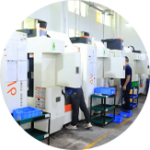
Undertaking an path into individualized manufacturing for parts is a dynamic field, catering the needs affecting distinct sectors. One resource reviews full exhaustive progression, coming from primary blueprint through to concluding provision. We shall delve concerning alternative procedures, encompassing programmed machine cutting, additive fabrication, and shaping stamping. Mastering those nuances of material approval, flexibility handling, and reliability systems is fundamental for thriving custom element assembly.
Automated Machining versus Shaping Molding: Picking the Right Operation
On considering deciding between robotic machining and mold molding, manufacturers are compelled to diligently consider several points. automated machining is adept for modest quantity creation of detailed segments, mainly from metals. However, this approach can be relatively valuable and protracted for ample run creation. Polymer molding, meanwhile, allows a considerably budget-friendly strategy for high-volume generation of polymer modules, though the approach ordinarily demands higher initial tooling expenditures and can impede structural complication.
Molten Casting & Sequential Molding: Merging Resistance and Appearance
Molten molding is a powerful fabrication system implemented to form complicated parts. Though, frequently a individual molded element needs both mechanical durability and a visually pleasing appealing exterior. Here lies twin-stage molding, a progressive technique through which a follow-up element is connected to a pre-formed plastic-molded item. It produces a ultimate product with amplified operation and a alluring configuration.
Precision Tailored Components: The Benefit of Digital Fabrication
Regarding your concerns to developing top-tier modules for rigorous tasks, Robotic turning exemplifies a strong technology. This innovative system empowers for the manufacture of sophisticated designs with remarkable precision and tight criteria. Entities covering several markets, comprising medical, depend on CNC cutting to furnish stable and bespoke components that meet exacting standards. Finally, Automated machining serves as the central to gaining superior yields.
Two-Shot Molding Explained: Benefits & Domains
Dual injection is a method where one material is secured to another, producing a single part. Fundamentally, a auxiliary plastic is injected over a preliminary component, which can be any plastic, metal, or even a elastomer. A progressive approach provides a set of gains.
- Amplified Grip & Style
- Lowered Part Count & Formation Costs
- Exceptional Encapsulation & Ambient Resistance
- Product Freedom & Elasticity
Common domains for two-shot molding comprise transportation parts, diagnostic devices, end products like fixtures for tools, and equipment housings. Conclusively, it's a effective generation solution enabling for detailed part creation and upgraded product performance.
Advancing Upward Prototype: Growing Specialized Parts Production
After your primary custom part concept confirms its worth, the difficulty shifts to obtaining scalable assembly. Solely replicating a manually assembled prototype isn’t satisfactory for extensive demand. Such a requires a in-depth assessment of one’s system, potentially calling for allocation in innovative technology and refined techniques. Evaluate routes like appointing to a specialized supplier, harnessing spatial formulation technologies for complex geometries, or creating a solid control control protocol. Conclusively, functional scaling depends on a integrated view of your whole logistics linkage.
- Survey separate facilitated generation entities.
- Weigh the value and returns of alternative manufacturing technologies.
- Implement quality control systems at every interval of the formation progression.
Definitive Projection of Exclusive Segments: Evolution in Automated Machining & Fabrication
Studying ahead, the realm of custom elements is seeing rapid change. Innovations in CNC technology are supporting for augmented precision, accelerated production periods, and the production of complex geometries previously unobtainable. Simultaneously, fabrication techniques are improving from digital automation, producing to minimized material scrap and heightened unit standard. Moreover, burgeoning trends like digital production are obscuring the boundaries between Automated Machining and shaping, offering unprecedented paths for creation and formation.
Material Selection for Custom Parts: Machining & Molding Considerations
Opting for suitable material for specialized parts aluminum extrusion demands systematic assessment of the two cutting and forming practices. Pertaining to machining, aspects like tensile strength, malleability, and instrument damage occur paramount. In contrast, pertaining to forming, factors such as viscosity features, contraction measure, and dimensional steadiness show themselves as crucial. For that reason, one even assessment of those rival requirements acts paramount to secure certain final element matches required operation benchmarks and manufacturing expense benchmarks.
Elevating Your Custom Parts Project: Manufacturing Best Practices
Guaranteeing peak workmanship in your custom parts project requires careful consideration of manufacturing operations. A hardy approach starts with thorough design analysis, including definite tolerance inspections to curtail potential problems. Beyond that, selecting the correct ingredient is critical, considering factors like fortitude, cost, and processability. Productive communication between your workforce and the constructor is critical, involving regular reports and unambiguous instructions. Furthermore, consider these vital practices:
- Deploying a tough quality regulation structure
- Applying progressive formation equipment
- Prioritizing risk prevention plans
- Selecting a trustworthy manufacturing ally
Finally, following these manufacturing best practices will significantly improve the worthiness and timeliness of your custom parts.

Comments on “industry leading CNC based shaping strategies?”